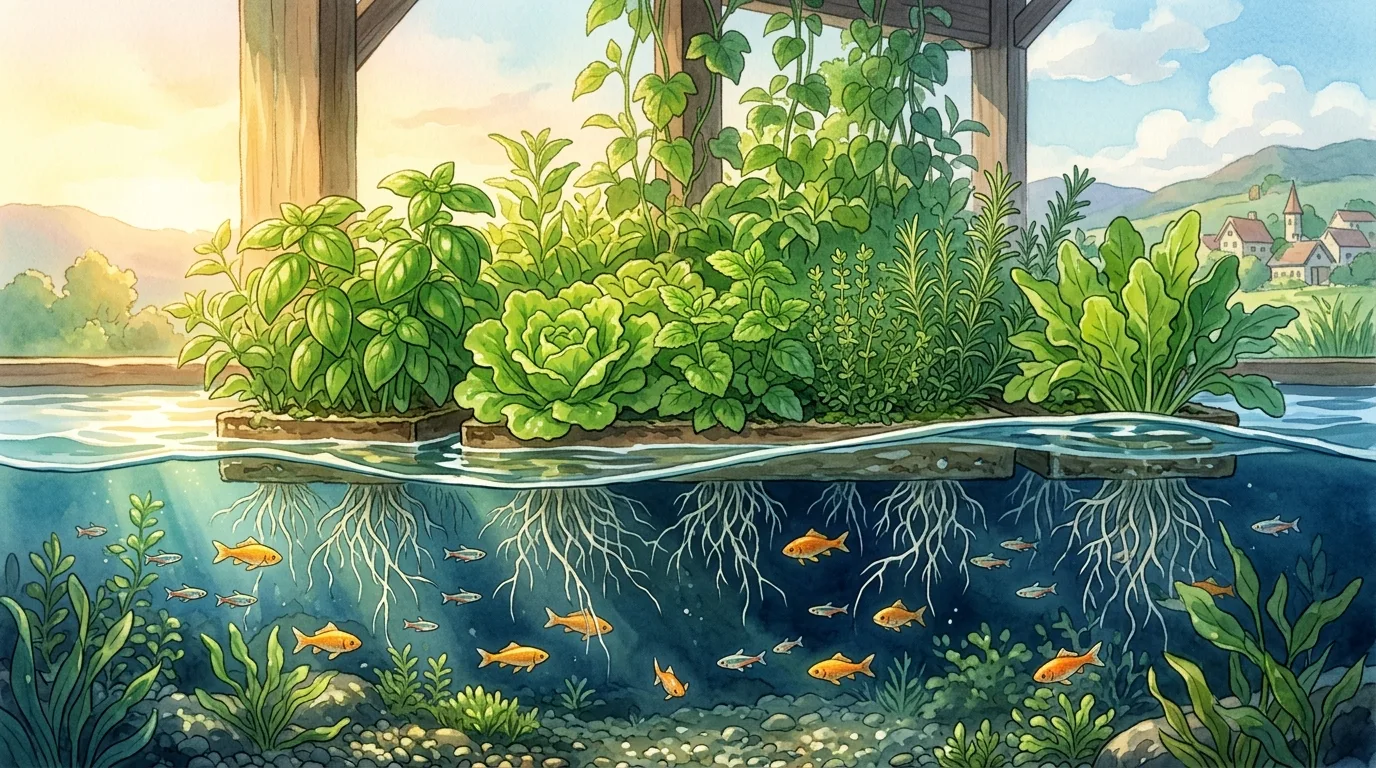
There is a predictable failure pattern in desktop aquaponics: someone sets up a compact system, adds fish immediately, and watches it crash within two weeks. The fish die, the water turns green, and the conclusion is that aquaponics is difficult or unreliable. The conclusion is wrong. The system failed because the biological infrastructure was never established before it was loaded.
A desktop aquaponics system can run stably for years with very little weekly maintenance. Getting there requires following the correct sequence during setup. Skip a step or rush the timeline and you build a fragile system that demands constant intervention.
Choosing the Right Tank Size
The minimum practical tank size for a stable desktop aquaponics system is 3 gallons. Below that, water chemistry changes too rapidly for most beginners to manage.
Five to ten gallons is the sweet spot for first-time setups. The water volume provides enough buffering that a day or two of inattention does not immediately produce a crisis. It is also large enough to support a small school of fish alongside a properly sized grow bed.
The grow bed should have volume equal to roughly one-third to one-half the tank volume. In a five-gallon system, that means a grow bed holding approximately 1.5 to 2.5 gallons of media. This ratio ensures enough bacterial surface area and plant root volume to process the bioload from the fish.
Selecting and Preparing the Grow Media
Expanded clay aggregate (hydroton, LECA) is the standard choice for compact aquaponics grow beds. It is pH-neutral, reusable, provides good drainage and aeration during the drain phase of a flood-and-drain cycle, and has enough surface area to support a substantial bacterial population.
Prepare the media before use: rinse it thoroughly until the runoff is clear, then soak it in pH-neutral water for 24 hours. Fresh clay aggregate can have a slightly alkaline surface residue that will push your system pH above 8.0 during cycling. Most beneficial bacteria and most plants prefer 6.8 to 7.2.
Lava rock is a lower-cost alternative with even higher surface area per unit volume. It is heavier, harder to rinse, and slightly more variable in pH behavior, but it performs equivalently once established.
The Cycling Phase: The Most Important Four Weeks
Do not add fish until the system has cycled. This is not optional advice.
Cycling means establishing the two bacterial populations responsible for nitrification: Nitrosomonas (converts ammonia to nitrite) and Nitrospira (converts nitrite to nitrate). Neither population exists in meaningful numbers in a new system. Both take time to grow to a density that can process the continuous ammonia output of living fish.
Add a source of ammonia to the filled system. Pure ammonia (ammonium hydroxide, fragrance-free and surfactant-free) at a dose that brings the tank to approximately 2 ppm is the most controllable method. Test the water every two days with a liquid test kit.
The progression runs in three stages: first, ammonia rises to target level while nitrite and nitrate stay at zero. Then nitrite begins to rise as Nitrosomonas colonizes, and ammonia drops as it is converted. Finally, nitrite falls as Nitrospira colonizes, nitrate rises, and ammonia drops to near zero.
The system is cycled when you can dose ammonia to 2 ppm, return 24 hours later, and find ammonia at or near zero, nitrite at or near zero, and nitrate elevated. That typically takes three to five weeks from a cold start.
Adding Fish: Stocking the Right Way
Add fish only after the cycling test passes. Stock conservatively on day one, at half the intended final load. Give the system two weeks to adjust bacterial populations to the new continuous ammonia source before adding the remaining fish.
For a 5-gallon desktop system, appropriate stocking includes one male Betta (by itself), 6 to 8 chili rasboras or ember tetras, or 6 to 8 white cloud mountain minnows. Goldfish are frequently suggested but should be avoided in any system under 20 gallons.
What Stable Looks Like
After 60 to 90 days, a correctly set up desktop aquaponics system reaches a steady state that genuinely requires minimal intervention. Weekly tasks: top off evaporated water, feed fish daily, harvest plant growth as needed. Monthly tasks: inspect the pump and intake for clogging, check pH.
Water changes become infrequent or unnecessary because the plants are continuously removing the nitrate that a conventional aquarium would require water changes to control. That steady state is the actual claim behind "low maintenance."
Plant selection in aquaponics is usually framed as a growing question: what will produce well in a flood-and-drain bed? That framing is incomplete. Plants in an aquaponics system are not just crops. They are the final stage of the filtration chain. The species you choose, and how you manage them, determines how much nitrate and phosphate the system removes from the water column.
The plants that work best in aquaponics filtration share specific traits: fast nitrogen uptake, tolerance for wet roots, and a root architecture that maximizes surface contact with recirculating water.
Basil
Basil is the benchmark plant for aquaponics filtration performance. It establishes quickly, produces a dense, fibrous root mass within two to three weeks of germination, and has a nitrogen demand that tracks well with the output of a lightly stocked fish tank. In a desktop system with a single Betta or a pair of small fish, one or two basil plants in the grow bed will typically keep nitrate below 40 ppm without any water changes once the system is cycled.
The practical advantage beyond filtration: basil signals system health visually. Pale, yellowing leaves indicate nitrogen deficiency. Dark, over-saturated green with leggy growth suggests the opposite: fish load exceeds plant uptake and nitrate is accumulating.
Watercress
Watercress is native to flowing water and its filtration performance reflects that. It is among the fastest nitrogen-uptaking plants available for aquaponics. Studies on constructed wetlands consistently show watercress removing nitrogen at rates that outpace most terrestrial herbs by a significant margin.
For desktop systems, watercress has one limitation: it grows fast enough to overwhelm a small grow bed within four to six weeks. Harvest the top third of the plant every two weeks and it will regenerate without becoming root-bound.
Lettuce
Loose-leaf lettuce varieties, particularly butterhead and oakleaf, are the most forgiving aquaponics plants for beginners and among the most consistent performers in continuous-harvest systems. They establish faster than basil, tolerate a wider pH range (6.0 to 7.5), and produce a root structure that colonizes media thoroughly without causing flow restriction.
A three-plant rotation in a small grow bed, staggering planting by two weeks, maintains near-constant uptake throughout the year.
Mint
Mint is an aggressive nitrogen scavenger. It develops a lateral rhizome root system that spreads through grow bed media and creates a dense uptake surface. For systems that are overstocked relative to grow bed size, mint can function as a buffer that keeps nitrate manageable while you adjust fish load or expand grow area.
The management requirement is containment. In an open media bed, mint will monopolize space within one growing season. Keep it in a mesh pot within the grow bed or dedicate a separate media zone to it.
Peace Lily
For purely ornamental setups, peace lily (Spathiphyllum wallisii) is the standard recommendation. It tolerates low light, thrives with its roots in direct water contact, and removes both nitrate and phosphate efficiently.
Peace lily is also one of the few aquaponics-compatible plants that can grow with its roots submerged rather than in flood-and-drain media. In open-top aquarium setups where the plant sits above the tank with roots trailing into the water, it functions as a continuous passive filter without any pump-driven media cycle.
Matching Plant Selection to Fish Load
Measure nitrate weekly for the first eight weeks after cycling. If nitrate is climbing above 60 ppm, either add more plant mass, increase harvesting frequency on existing plants, or reduce fish load. If nitrate is stable below 20 ppm with no water changes, your plants are outpacing your fish and you have capacity to increase stocking density.
Plant selection is not a one-time decision. It is an ongoing calibration against the biological load in the tank.
Most people who keep fish treat filtration as a single problem: remove visible waste. They buy a hang-on-back filter, stuff it with carbon and foam, and call it done. That approach keeps a tank running, but it misses the core mechanism that makes aquaponics so different from conventional aquarium-keeping, and so much more stable once it is set up correctly.
Aquaponics filtration is not one process. It is three simultaneous biological and mechanical processes that have to be balanced against each other. Get that balance wrong and you get either fish stress or nutrient-starved plants. Get it right and the system becomes genuinely self-regulating in a way that a standard aquarium never achieves.
Mechanical Filtration: Capturing Solids Before They Break Down
The first stage is straightforward: physical removal of solid waste before it has a chance to decompose in the water column. Fish excrete solid waste constantly. If that waste sits in the water and breaks down anaerobically, it produces ammonia spikes, hydrogen sulfide, and a biological oxygen demand that the rest of the system cannot handle.
In a desktop or small-scale aquaponics system, mechanical filtration typically happens through a grow bed filled with media, such as expanded clay aggregate, lava rock, or similar porous material, that physically traps solids as water flows through. The media acts as a settling bed and a biofilm surface simultaneously.
Biological Filtration: The Nitrogen Cycle Is Not Optional
This is where aquaponics diverges most sharply from hydroponic growing and from conventional aquarium management. The nitrogen cycle has to be fully established before the system can support both fish and plants at healthy densities.
Ammonia is the direct output of fish metabolism. At concentrations above about 2 ppm, it is acutely toxic to most freshwater fish. The colonies of Nitrosomonas and Nitrospira live primarily on surfaces, on the media in the grow bed, on the walls of the tank, on any submerged structure with sufficient surface area and oxygen exposure. This is why media selection matters: you are not just picking a physical filter substrate, you are engineering habitat for bacteria.
Expanded clay has a surface area of roughly 250 to 300 square meters per cubic meter. That translates directly into the bacterial biomass the system can support and therefore the fish load the system can handle.
Cycling a new system typically takes three to five weeks. There are no shortcuts. Adding fish too early crashes the system before the bacterial population can process the ammonia load.
The Plant Uptake Stage: Where the System Closes the Loop
Once nitrate is present in the water, the plants take over. Roots in direct contact with the recirculating water absorb nitrate, phosphate, and trace minerals. In a correctly stocked system, plant uptake keeps nitrate below 80 ppm.
This is the feedback loop that makes aquaponics self-regulating: fish produce ammonia, bacteria convert it to nitrate, plants consume the nitrate, and clean water returns to the fish. The conventional aquarium requires regular partial water changes to remove accumulated nitrate. A balanced aquaponics system does not, because the plants are continuously performing that function.
Why Desktop Systems Challenge These Principles
Scaling aquaponics down to desktop size compresses every margin for error. Water volume is small, so ammonia spikes are faster and more severe. The grow bed has less surface area for bacterial colonization. Temperature fluctuations from ambient room conditions affect bacterial activity directly: Nitrosomonas works optimally between 25 to 30 degrees Celsius and slows significantly below 20.
The design choices that make a compact system work center on maximizing the biological surface area relative to the water volume, maintaining a flood-and-drain cycle that keeps the grow bed alternately wet and oxygenated, and selecting a fish species whose bioload matches what a small grow bed can process.
What "Low Maintenance" Actually Means
When a compact aquaponics system is marketed as low maintenance, that claim is accurate, but only after the cycling period is complete and the system is correctly stocked. During the first month, the system demands close attention: daily ammonia and nitrite testing, conservative feeding, and patience.
After that establishment period, maintenance genuinely drops. Understanding the three processes, mechanical capture, biological conversion, and plant uptake, is the prerequisite for troubleshooting any problem that appears later. Cloudy water, fish gasping at the surface, yellowing plants: each symptom maps to a specific stage in the filtration chain. Fix the process, and the symptom disappears.